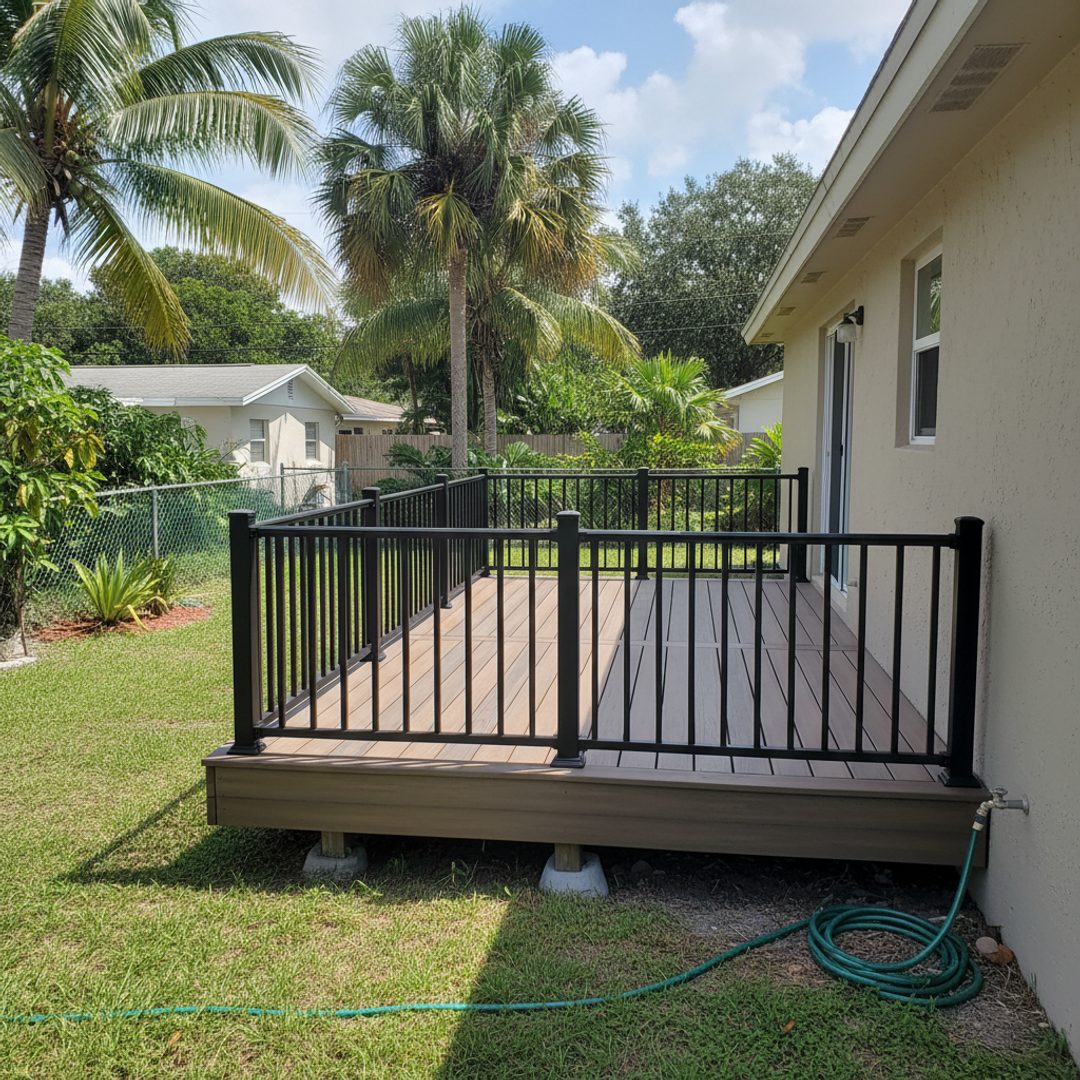
Most homeowners think about the boards on top. The part that actually decides whether a deck lasts eight years or twenty-five is six to eight feet below them, and in this part of Broward County that ground is not what it is in most of the country.
Sand over rock, and sometimes fill over muck
A lot of Fort Lauderdale sits on sandy soil over limestone, part of the old Anastasia and Miami oolite formations. That sand drains fast, which is good news for a footing, but it doesn't hold a post the way clay does further north. In older sections like Rio Vista, Victoria Park and Coral Ridge, built mostly in the 1950s and 60s, you hit that sand-and-rock pretty quickly. Further west, in neighborhoods that were built up in the 80s, 90s and 2000s toward Plantation, Davie and Weston, a lot of that ground is fill placed over old Everglades wetland. That fill can be loose, uneven in depth across one lot, and it settles differently than native sand. Before we set a single footing, we want to know which situation we're dealing with, because a footing design that works on solid sand can shift on compacted fill.
The water table changes how we dig
Fort Lauderdale's water table often sits two to four feet down, and closer to that on canal-front lots. Auger a footing hole here and it's not unusual to hit water before you hit the depth you need. That means pumping the hole before we pour, or using a concrete mix designed to be placed in standing water, or in some cases switching to a helical pile that gets screwed down to a load-bearing layer instead of relying on a poured footing at all. None of that is frost protection, because frost isn't the issue here the way it is in Ohio or Minnesota. What matters in this soil is reaching ground that won't wash out from under the footing or let it float during a wet summer.
That wet summer is real and it's predictable. June through September, Fort Lauderdale gets afternoon thunderstorms that can drop two to three inches of rain in under an hour. Most lots here are flat, drainage runs slow, and a yard that looks dry in March can hold standing water for a day after a July storm. We grade under a deck to move that water away from the house, not toward it, and we keep footings set above the level where that water typically sits once it's had time to drain.
Termites do more damage here than weather does
Up north, builders worry about freeze-thaw cracking a footing. In South Florida, subterranean termites are the bigger threat to a deck's frame, and they're active here year-round, not seasonally. Any framing lumber has to be pressure-treated and rated for ground contact if it's within 6 inches of soil, and even treated lumber benefits from a joist tape over the top edge to stop water from wicking into the cut ends and giving termites a soft spot to start. We don't use untreated dimensional lumber for any structural member on a Fort Lauderdale deck, full stop, regardless of what's hidden under the decking once it's built.
Composite decking helps here too, not because it's trendy, but because the boards themselves can't be eaten and won't cup or splinter the way a wood board does after a few humid summers. The frame underneath still has to be real lumber or steel, and that frame is where the termite and rot risk actually lives.
Hurricane wind load isn't optional paperwork
Broward County sits inside Florida's High-Velocity Hurricane Zone, which changes what hardware is legal to use on an attached deck. Lag screws that would pass inspection in a lot of states don't meet the uplift requirements here. Ledger boards get through-bolted, not lag-screwed, and joist-to-beam connections need rated hurricane ties sized for the wind load the structure has to resist, not just gravity load. This isn't about being extra careful, it's what the Florida Building Code requires for this county, and it's one of the first things an inspector checks.
If your deck is anywhere near the Intracoastal or one of the canals, add saltwater corrosion to the list. Standard galvanized fasteners break down faster in that air than they would three miles inland. We spec stainless steel hardware, usually 316-grade, on anything close to brackish water, even though it costs more up front, because replacing corroded hangers under a deck five years in costs a lot more.
Permits, flood zones, and what gets checked
The City of Fort Lauderdale's Building Services department issues most deck permits inside city limits, with Broward County handling unincorporated areas. An inspector will look at footing depth and placement, the ledger attachment to the house, hurricane tie-down hardware, and railing height and baluster spacing if the deck sits more than 30 inches off grade. A lot of Fort Lauderdale properties sit in a FEMA flood zone, which can affect what's allowed below a certain elevation on a deck attached to the house. If your lot has an elevation certificate on file from when the house was built, that document saves time during permitting. HOAs are common in the canal communities and the gated subdivisions further west, and most of them want a copy of the deck plan before the city even sees it, so check that early rather than after materials are ordered.
None of this is the kind of thing a homeowner needs to memorize. It's the kind of thing a builder needs to already know before the first auger goes in the ground. That's the work Oasis Deck Company does on every job here, from a small resurfacing project to a full custom build on a canal lot.