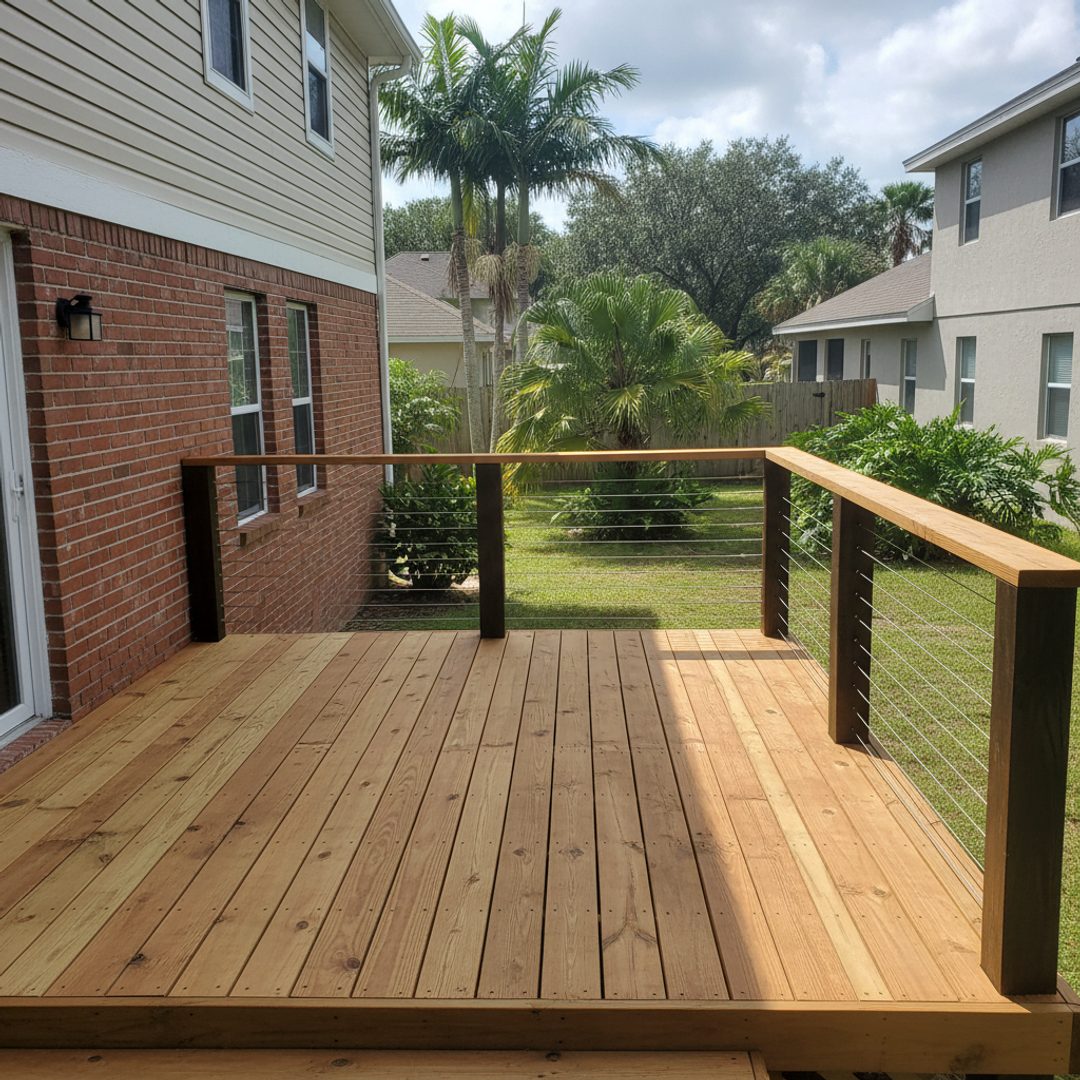
Ask five homeowners what their deck cost and you'll get five different numbers that don't mean much without context. A 300 square foot pressure-treated deck and a 300 square foot deck on a seawall with cantilevered framing are not the same job, even if they sound similar on the phone. The number depends on what's underground, what's attached to the house, and what the county wants to see before it signs off.
Here's what actually moves the price, in the order it usually shows up.
The framing and footings, not the decking itself
Most homeowners think about the boards on top. The bigger cost is usually what's holding them up. A deck more than about 30 inches off grade needs footings sized for wind uplift, not just weight, because Fort Lauderdale builds to withstand hurricane-force gusts even on a backyard structure. That means concrete footers poured 24 to 36 inches deep with embedded post bases, not the quick 12-inch tube forms you'd get away with in a calmer climate. If the deck attaches to the house, the ledger board has to be bolted and flashed correctly, and if the siding is stucco, cutting into it and re-flashing it properly adds labor that has nothing to do with decking material at all.
Joist spacing matters too. Composite decking generally wants 12 inches on center instead of the 16 inches you can get away with under pressure-treated pine, because composite boards flex more over a span. More joists means more lumber and more time, even before anyone picks a board color.
Material cost per square foot, roughly
This is the range most people actually want, so here it is with the caveat that site conditions swing it either direction:
- Pressure-treated pine, standard build: often lands somewhere in the $15 to $25 per square foot range installed, framing included.
- Capped composite (Trex, TimberTech and similar): usually $35 to $55 per square foot installed, depending on board profile and railing choice.
- PVC decking: at the top end, often above composite, because the material itself costs more and some profiles need different fastening systems.
Pressure-treated pine is cheaper up front but it moves. In our humidity it holds moisture, and a board installed slightly damp will shrink and gap as it dries over the first summer. Composite doesn't do that, which is part of why the price gap exists. It also doesn't need the staining and sealing that pine needs every 18 to 24 months to keep it from graying and cracking under UV.
Salt air and fasteners nobody sees
Fort Lauderdale is a coastal city, and that changes what goes into the deck even if it never shows up on the invoice as a separate line. Standard zinc-coated screws corrode fast within a mile or two of the Intracoastal or the beach. Hot-dip galvanized or stainless steel fasteners cost more, sometimes significantly more on a large deck, but a deck built with the wrong hardware starts bleeding rust streaks down the boards within a year or two. That's a repair call waiting to happen, and it's one of the more common reasons we get asked to fix a deck that's barely five years old.
Permits, flood zones, and what the city actually checks
Most deck work in Fort Lauderdale needs a permit through the city or through Broward County if you're in unincorporated area, and that's true even for a modest attached deck, not just big builds. The inspector is generally looking at footing depth and placement before the concrete goes in, then framing and ledger attachment, then a final once railings and stairs are up. Skipping that process doesn't save real money, because you're on the hook for it at resale when a buyer's inspector flags an unpermitted structure.
A lot of Fort Lauderdale neighborhoods sit in flood zones, particularly closer to the water in areas like Rio Vista, Harbor Beach, and the finger-island streets off Las Olas. If your house is elevated or on pilings, the deck or dock-adjacent structure may need to account for base flood elevation, which can mean taller posts, different footing requirements, and sometimes a conversation with a surveyor if setbacks are close to the lot line. None of that is unusual, it's just part of building near the water here, and it adds time and cost that an inland deck in, say, Plantation or Davie usually doesn't carry.
HOAs are common in a lot of the newer gated communities and condo-adjacent developments. If yours has an architectural review committee, budget a few extra weeks for approval before permitting even starts. That's a timeline cost more than a dollar cost, but it affects the total project either way.
Repair versus replace, and where the line actually sits
Not every deck problem needs a full rebuild, and we'll say so even when a bigger job pays more. If the framing underneath is sound and it's just the surface boards that are cupped, splintered, or soft from years of sun, board replacement is usually a fraction of the cost of tearing the whole thing out. The test is simple: a screwdriver pressed into the joist at the point where it meets the ledger or a support post. If it sinks in soft, that's rot, and that's a structural repair, not a cosmetic one. If the wood is solid and just weathered, resurfacing with new boards over existing framing can often save 40 to 60 percent compared to a full rebuild.
Where it gets more expensive is when the rot has reached the posts or the ledger connection to the house. That's not optional repair work. A deck that's structurally failing at the ledger is a safety issue, not an aesthetic one, and it's the kind of thing that shows up after a few years of water sitting where it shouldn't, usually because the flashing was wrong from the start or never there at all.
If you want a straight answer on what your specific deck needs and what it'll actually run, that's a conversation worth having in person rather than guessing off square footage. We look at the framing, the grade, and what's attached to the house before we put a number on paper. You can see the range of work we handle at Oasis Deck Company.